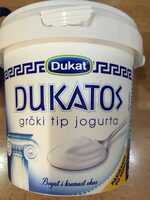
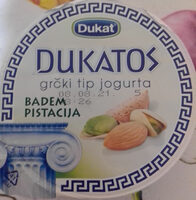
Photo: Open Food Facts contributors, CC BY-SA
At a glance
jogurt (dukat) is a product in the category “Yogurts”. It provides 37 kcal (156 kJ) per 100 g. It contains 57% less sugar than the median product in its category. It contains 83% less saturated fat than the median product in its category. Its salt content is close to the median of its category. No E-number additives were identified in its ingredient list. It is sold in Croatia and Slovenia.
Nutrition facts
| Nutrition facts | Per 100 g / 100 ml | % RI* |
|---|---|---|
| Energy | 156 kJ / 37 kcal | 2% |
| Fat | 0.5 g | 1% |
| Saturated fat | 0.3 g | 2% |
| Carbohydrates | 4 g | 2% |
| Sugars | 4 g | 4% |
| Added sugars | 0 g | |
| Protein | 3.7 g | 7% |
| Salt | 0.11 g | 2% |
| Calcium | 120 mg | |
| Fruits, vegetables & legumes | 0 % |
*Reference intake of an average adult (8400 kJ / 2000 kcal).
Compared with similar products
Median values of 4,142 products in the category “Yogurts”.
Ingredients
Pasterizirano mlijeko s 0.5% mliječne masti, jogurtna kultura.
Allergens
No allergens declared on the label.
Additives
No E-number additives were identified in the ingredient list.
Frequently asked questions
How many calories are in jogurt?
jogurt contains 37 kcal per 100 g.
Is jogurt vegan?
No. The ingredient list of jogurt contains at least one animal-derived ingredient.
Does jogurt contain palm oil?
No palm oil was detected in the ingredient list of jogurt.
Which additives does jogurt contain?
No E-number additives were identified in the ingredient list of jogurt.